





The One Habit That Ties Your Whole Gut Reset Together
You've done the reading. You've bought the kefir. You've thought seriously about fiber. Here's the part that actually makes it stick.
Welcome to the end of April. You made it. And if you've been following along this month, your relationship with your gut has probably shifted (even slightly, even grudgingly) in a good direction.
You know things now. You know your microbiome has a circadian rhythm. You know that the bloating you blamed on gluten for three years was probably just too much fiber too fast. You know that the gut-brain axis is real, that your mood and your digestion are genuinely connected, and that the kefir in the back of your fridge is not just a personality accessory. It's actually doing something.
The question at the end of a month like this is always the same: what do you actually keep?
Because here's the thing about gut health content (and wellness content generally). It's very good at making you feel educated and very bad at making you feel like you know what to do on a Tuesday morning when you're tired and you've run out of yogurt and you're not entirely sure whether you took your magnesium last night. The information is all there. The habit is the bit that's missing.
The wellness paradox, as experienced by most people
Week 1: I am going to completely overhaul how I eat. Fermented foods daily. Fiber up to 30g. Early nights. Water. All of it.
Week 2: I did most of it. The kimchi is still going. I'm proud of myself.
Week 3: I've had a busy week. I'll restart on Monday.
Week 4: What was I even doing? Was it the kefir? I think it was the kefir.
The reset didn't fail. The habit architecture did.
A quick April recap: what actually moved the needle
This month we covered a lot of ground. Here's the condensed version: the things that are actually worth holding onto when life gets in the way of reading wellness blogs:
April 2026: What We Covered
- Your gut microbiome shifts seasonally; spring is an opportunity, not a given
- Fiber works best when you add it gradually; bloating is transition, not failure
- The gut-brain axis is real; your digestion and your mood are not separate systems
- Sleep timing matters as much as sleep duration; your gut runs on a clock
- Consistency over intensity, always. A small daily thing beats a big weekly thing every time
These are all true. They're all backed by solid science. And they all share a frustrating property: they require you to do something consistently, over time, without an obvious moment of triumph to confirm they're working.
Which brings us to the actual point of today's post.
Why habits die and what to do about it
There's a reason the most successful health habits in the research literature tend to be simple, time-anchored, and attached to something you already do. Not because people are lazy (though, also, yes, we're all human), but because the brain doesn't build habits from good intentions. It builds them from repetition within consistent contexts.
"I'm going to eat more fiber" is an intention. "I'm going to add a spoonful of kefir to my morning smoothie, every morning, before I check my phone" is a habit. The difference is specificity of time, place, and action. Research on habit formation consistently finds that people who attach new behaviors to existing cues, known as implementation intentions, are significantly more likely to sustain them at 8 weeks, 12 weeks, and beyond.
The trouble with gut health as a category is that most of its recommendations are scattered across the day. Fiber at breakfast. Fermented food at lunch or dinner. Water before meals (which meal?). Movement after eating. Sleep at a consistent time. Magnesium before bed. It's not that any of these are difficult. Together, they require remembering six different things at six different moments. And remembering is not a reliable habit-building strategy. Life intervenes. Remembering fails. The habit evaporates.
The habit research is pretty clear on this: the fewer decisions a habit requires in the moment, the more likely it is to survive contact with a real week. You want one anchor. Everything else radiates from it.
The one habit, and why it's this one
If you could only keep one thing from April, one thing that would do the most work across the most systems with the least friction: a consistent evening ritual.
Not because evenings are magical. Because the evening is the one moment in the day where most people have agency, a few minutes, and an existing routine that a new habit can attach to. You already brush your teeth. You already wind down somehow. You already have a moment, however brief, that belongs to you before sleep. That's your anchor.
The Habit
The Nightly Gut Ritual, and why it compounds
An evening gut ritual works on three systems simultaneously, which is unusual for a single daily habit.
Digestion: Taking digestive enzymes in the evening supports the processing and repair work your gut does overnight: the quiet, largely invisible maintenance that determines how you feel the next morning.
Sleep: Magnesium, taken consistently in the evening, helps regulate the nervous system and improve sleep onset. Better sleep improves gut motility, reduces cortisol, and supports the gut-brain axis, which then improves digestion. The cycle runs in your favor.
Consistency itself: An evening ritual is self-reinforcing in a way that daytime habits often aren't. You feel the effects in the morning. The morning feeling reminds you why you did it. You do it again that evening. That loop (habit → result → habit) is how genuine long-term behavior change actually happens.
It's not a cure and it's not a quick fix. It's a compounding system. After a week you'll notice small things. After a month you'll wonder how you weren't doing this already.
What the next four weeks look like if you stick with it
Not a dramatic before-and-after. Something more useful: a genuine shift in baseline.
- Week One: The habit forms. You're attaching it to something: teeth, phone on charge, whatever works. Some nights you'll forget and catch it late. That's fine. The anchor is still taking hold.
- Week Two: The mornings start to shift. More regular. Slightly better sleep. A morning that doesn't require two coffees just to feel operational. Subtle, but real. You'll notice it because you're paying attention.
- Week Three: The compounding kicks in. The fiber habits feel easier. The fermented foods feel like a natural part of eating, not a health task. The magnesium is doing its quiet work on your nervous system. The whole system is running a little better.
- Week Four: You've stopped thinking about it. Which is exactly the point. The best habits are the ones you barely notice anymore. They've become the thing you just do. Your gut is in better shape going into summer than it was in April. Job done.
A final word on all-or-nothing thinking
The last thing we want to say at the end of a gut reset month, to readers who have genuinely tried things and made real changes, is: you have to do all of it, every day, perfectly, or it doesn't count.
That's not how gut health works. It's not how habits work. It's not how biology works. Your microbiome is extraordinarily adaptive and it responds to the general direction of your lifestyle, not to whether you had a bag of chips on Wednesday or missed your ritual on the night you fell asleep on the sofa at 9pm watching something embarrassing.
The research on microbiome resilience is actually quite encouraging on this front: consistent positive habits create a genuine shift in the composition and diversity of your gut bacteria over weeks, and that shift is relatively stable even when you have a few off days. You're building a better default, not maintaining a perfect streak.
So: keep what worked. Drop what didn't. Hold onto the evening ritual as your anchor. Let everything else attach to it gradually.
That's the whole reset, really. One good anchor. Everything else follows.
Thanks for spending April with us. Your gut is in better shape than it was on April 1st, and not just because of what you've eaten. Because of how you've started thinking about it. Which, quietly, is the thing that actually changes everything.
Share:
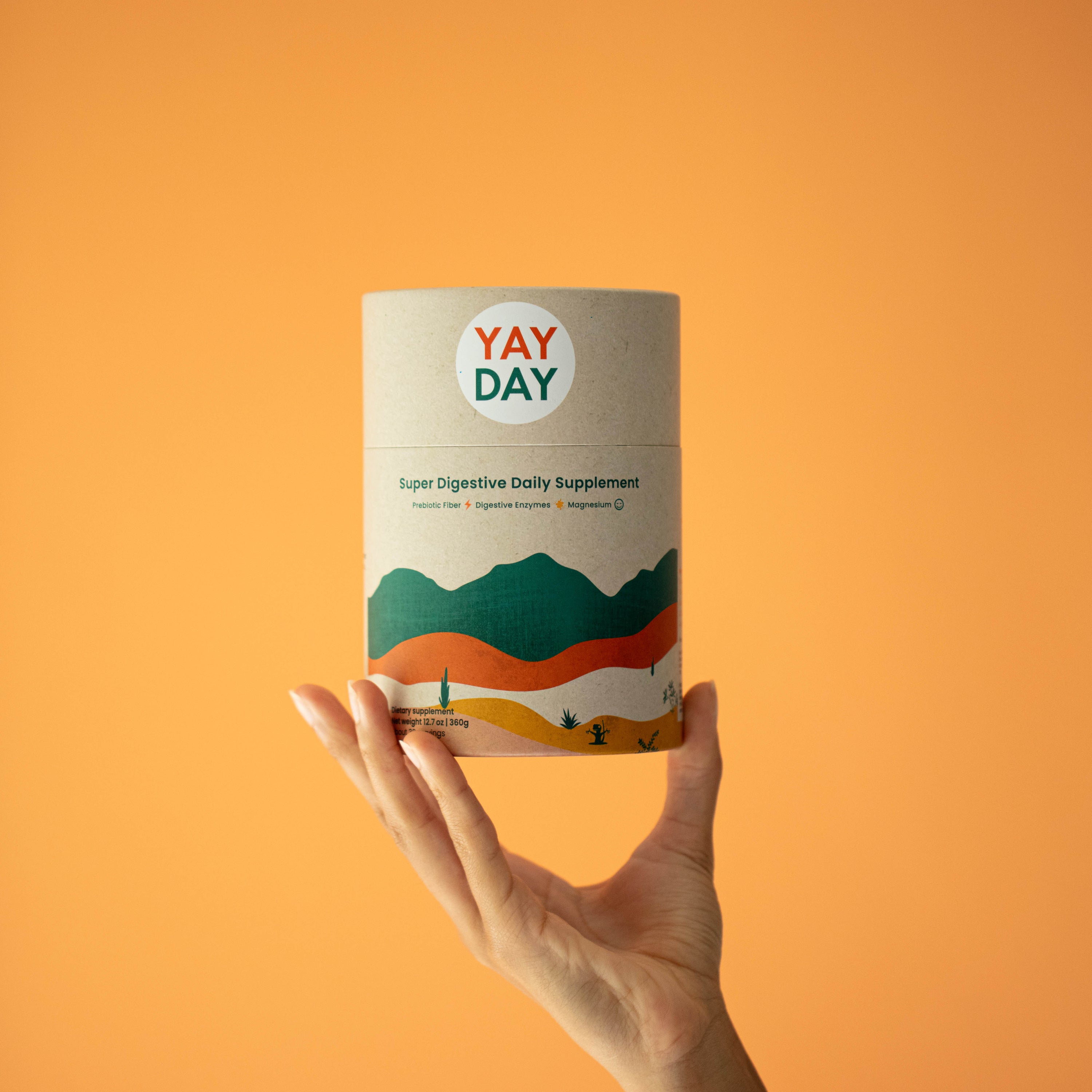
Sleep Better, Feel Better. It's That Simple.
We know that quality sleep and good gut health are the foundation of feeling your best. That's why YayDay was created to tackle both—overnight.
Dr. Roshini Raj, MD, explains that taking YayDay before bed allows the calming magnesium to help you drift off to sleep while the fiber blend gently gets to work. The result? You wake up feeling rested and your digestive system is primed for a comfortable and predictable morning.
- Calm Nights: Magnesium helps you unwind for deep, restorative sleep.
- Great Mornings: A gentle fiber blend works overnight for a smooth and satisfying start to your day.
Stop waiting for a good day to happen. Start one the night before with YayDay.
Blog posts
-

Your Gut and Your Brain Are in a Relationship. It's Complicated.
Before that big presentation, did your stomach hurt? Before an important event, did you get diarrhea? Did you lose your appetite completely when something went wrong, or eat the entire contents of your kitchen when you were anxious? That is...
-

Grilling Season Is Here. Your Gut Has Concerns.
Grilling season is here. Your gut has some thoughts about the charred meat, the three beers before noon, and the speed at which you eat a hot dog in a social setting. We broke down the five reasons cookout food reliably wrecks your digestion, and what to do about it without becoming the person who brings a sad salad.
-

The One Habit That Ties Your Whole Gut Reset Together
You've done the reading. You've bought the kefir. You've thought seriously about fiber. Here's the part that actually makes it stick. Welcome to the end of April. You made it. And if you've been following along this month, your...


